

Buy Niche Perfume Samples Online: 2026 Guide
Table of Contents
- Why Buying Niche Perfume Samples Online Beats Blind Buying
- Authentic Perfume Decants: How to Spot a Trustworthy Seller
- Sample Sizes, Spray Counts, and How Long Perfume Samples Last
- Niche Fragrance Discovery Sets vs Single Samples: Which to Choose
- How to Test Perfume Samples on Skin Before You Commit
- What to Expect on Price: Samples, Shipping, and Value
- Frequently Asked Questions
Last Updated: October 9, 2026
Why Buying Niche Perfume Samples Online Beats Blind Buying
Buying niche perfume samples online is the only sensible way to explore expensive fragrances before committing to a full bottle. Samples solve that problem for the price of a coffee.
A full bottle of niche fragrance often costs more than a week of groceries. A sample costs a few dollars. That gap is the entire argument.
Below, we break down how to choose a seller, compare sample formats, verify authenticity, and test fragrances properly so you never waste money on a bottle you regret.
Authentic Perfume Decants: How to Spot a Trustworthy Seller
Authentic perfume decants come from a full bottle that a seller transfers into a smaller vial by hand. The fragrance inside is the real thing. The risk is that not every seller does this honestly.
Here is what separates a trustworthy operation from a careless one:
- Clear sourcing language. The seller names the original fragrance house and batch where possible.
- Proper labeling. Every vial lists the fragrance name, concentration, and fill date.
- Real photos. Listings show the actual decanting setup, not stock images pulled from the brand's website.
- Responsive customer service. Questions about sourcing get direct answers, not copy-paste replies.
A common mistake is buying from a seller who cannot explain where the bottle came from. If the answer is vague, walk away. The Federal Trade Commission guidance on deceptive advertising makes clear that sellers must be honest about what they are selling, and fragrance decants are no exception.
Storage and Handling: What Proper Decanting Looks Like
Proper decanting happens in a clean, temperature-controlled space. Heat and direct sunlight break down fragrance molecules over time, which changes how a scent smells.
Sample Sizes, Spray Counts, and How Long Perfume Samples Last
How long do perfume samples last? A 2 ml spray vial typically gives you 20 to 30 sprays, which is enough for roughly 10 to 15 full wearings. A 5 ml decant doubles that.
Most people use two to four sprays per wearing. At three sprays a day, a 2 ml sample lasts about a week of daily testing. That is plenty of time to judge how a fragrance develops from the opening notes through the dry-down.
| Sample Size | Approximate Sprays | Full Wearings | Best For |
|---|---|---|---|
| 1 ml | 10-15 | 4-6 | Quick first impression |
| 2 ml | 20-30 | 10-15 | A week of daily testing |
| 5 ml | 50-75 | 25-35 | Confirming a full-bottle buy |
| 10 ml | 100-150 | 50-70 | Travel and regular wear |
Matching Sample Size to Your Testing Goals
If you are curious about a scent but not serious yet, a 1 ml or 2 ml vial is enough. If you already suspect you love it and want to confirm over several weeks, go bigger.
For travel, a 10 ml decant fits carry-on rules and gives you a fragrance you already know you enjoy. That is one of the quiet advantages of sampling first: you build a travel kit of scents you have already vetted.
Niche Fragrance Discovery Sets vs Single Samples: Which to Choose
Niche fragrance discovery sets group several samples from one house or theme into a single purchase. Single samples let you pick exactly what you want to try. Both have a place, and the right choice depends on what you already know.
Choose a discovery set when you are new to a brand and want to understand its style. Choose single samples when you have a specific fragrance in mind or want to compare two similar scents side by side.
A Neutral Way to Compare Sample Retailers
- Selection breadth. Does the shop carry the specific houses and concentrations you want, or only the bestsellers? A wide catalog matters less than overlap with your shortlist.
- Sample format. Spray vials, dabber vials, and rollerballs all behave differently. Sprayers give you a realistic application; dabbers are cheaper but harder to dose evenly.
- Price per vial and per milliliter. A $6 2 ml spray and a $6 5 ml dabber are not the same value. Normalize before you compare.
- Shipping cost and speed. Flat-rate, free-over-threshold, and per-vial shipping change the real cost of a small order dramatically.
- Return and damage policy. What happens if a vial leaks or arrives broken? A stated policy is worth more than a friendly email.
- Sourcing transparency. Batch references, fill dates, and real photos of the decanting setup separate careful sellers from resellers.
Discovery Sets: What They Are Good For
A discovery set is a curated bundle, usually from a single house or built around a theme like woody ambers or fresh citruses. The advantages are real:
- Lower per-sample cost. Bundles typically price each vial below what it costs to buy the same sample individually.
- A coherent education. Testing five scents from one house teaches you its signature, its favorite bases, its approach to sweetness, its longevity habits.
- Less decision fatigue. You stop hunting for individual vials and let the curation do the work.
The trade-off is that you rarely get to choose every scent in the box. If two of the five are notes you already know you dislike, your effective cost per useful sample climbs.
Single Samples: What They Are Good For
Single samples are the precision tool. You buy exactly the fragrance you are curious about, which makes them better for:
- Head-to-head comparisons. Two similar ambers, two rose-forward scents, two takes on vanilla, side by side is the only fair test.
- Chasing a specific note. If you are hunting a particular ingredient, singles let you build a focused lineup instead of accepting a house's curation.
- Testing before a gift. You can confirm a scent suits the recipient before spending on a full bottle.
The trade-off is shipping economics. Ordering one vial at a time means paying shipping repeatedly, which is why most experienced samplers batch their orders.
How to Decide
Ask one question: do you know what you want to smell, or are you still learning a house?
If you know, buy singles. If you are learning, buy a discovery set, then follow it with singles of the two or three scents that stood out. That two-step pattern gets you the education of a set and the precision of individual vials without paying full retail twice.
AR Aromas carries individual decants like Promise, a unisex amber-woody eau de parfum from Editions de Parfums Frédéric Malle with green apple, pink pepper, and dual rose notes over a patchouli and labdanum base. If you prefer something softer, Gris Charnel blends cardamom, fig, and black tea into a creamy sandalwood dry-down.


How to Test Perfume Samples on Skin Before You Commit
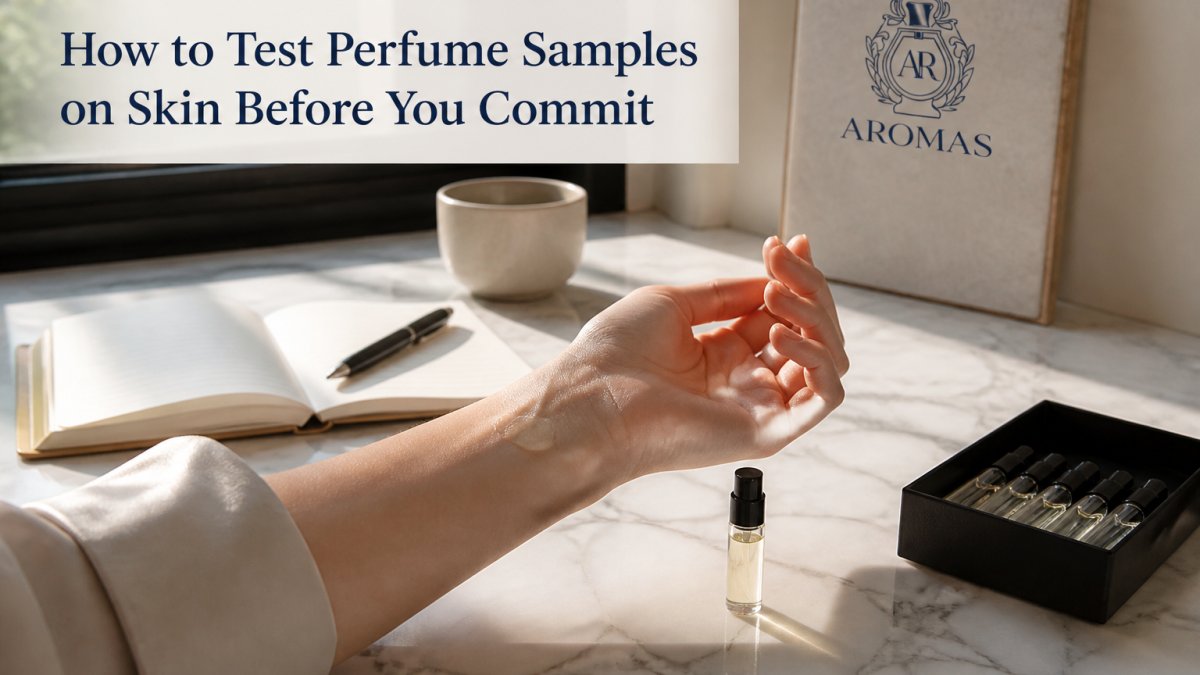
Testing on skin is the only way to know how a fragrance actually performs on you. Paper strips show the general shape of a scent, but body chemistry changes everything. A fragrance that smells sharp on paper can turn warm and rich on skin.
Follow this routine:
- Spray on clean, moisturized skin, never on top of another fragrance.
- Apply to one wrist and the opposite inner elbow so you can compare.
- Smell at 15 minutes, then again at two hours and six hours.
- Note how the scent changes and whether it fades too fast.
- Test only one new fragrance per day so your nose stays accurate.
Building a Testing Routine That Saves Money
Keep a simple log. Write down the fragrance name, the date, and what you thought at each checkpoint. After a month, patterns appear. You will notice which note families you keep loving and which ones you keep rejecting.
That log is what stops you from buying full bottles on impulse. It also tells you when a sample is worth upgrading. If you have worn a scent five times and still reach for it, that is your signal.
What to Expect on Price: Samples, Shipping, and Value
Sample pricing varies with concentration and rarity. An eau de parfum decant from a well-known house usually sits in the single-digit dollar range per vial.
At AR Aromas, samples start at $4.99 for a 2 ml decant, and a rare extrait like Pardon runs $14.99. Compare that to a full bottle of the same fragrance and the math is obvious.

But the sticker price on the vial is only part of what you pay. The rest shows up at checkout, and most retailer pages never spell it out.
The Full Cost of a Sample Order
Four line items decide whether a sample haul is a bargain or a mistake:
- Per-vial price. The number on the product page.
- Shipping. Either a flat rate, a free-shipping threshold, or a per-item charge. A single $5 vial with $8 shipping is a $13 sample.
- Tax. Applied at checkout based on your shipping address.
- Packaging surcharges. Some sellers add a small fee for padded mailers or rigid boxes. It is usually minor, but it should be visible before you pay.
The practical takeaway: shipping is the line item that punishes small orders.
Shipping: What to Ask Before You Order
Fragrance is heat- and light-sensitive, so how a seller ships matters as much as how fast. Before checkout, confirm:
- Tracking. A tracking number is table stakes. Without it, a lost package becomes your problem.
Returns and Damaged Vials
Fragrance samples are a consumable product, so most sellers do not accept returns on opened vials. That makes the damage policy the one that actually matters. Look for a stated commitment to replace or refund vials that arrive leaking, broken, or evaporated, and check whether you need to report it within a set window, often a few days of delivery.
If a seller's policy page says nothing about damaged shipments, ask before you buy. The answer tells you how they handle problems after the sale.
The Real Value Calculation
The value question is not price per milliliter. It is whether sampling saves you from one bad full-bottle purchase. A niche bottle can run into the hundreds of dollars; a handful of samples costs a fraction of that.
Frequently Asked Questions
How can you tell if a perfume sample is authentic?
Buy from sellers who hand-decant from sealed retail bottles and label each sample with the fragrance name, concentration, and batch details. Look for clear photos of the original bottle, consistent pricing across a catalog, and customer reviews that mention scent accuracy. If a niche perfume sample costs far less than others of the same brand, that is a red flag. Authentic perfume decants should smell identical to the retail bottle from the first spray to the dry-down.
How long do perfume samples last once I receive them?
A 2 ml sample typically gives 20 to 30 sprays, enough for several full-day wear tests.
Are niche fragrance discovery sets worth buying?
They are worth it when you want to explore a house or a scent family without committing to one full bottle. A curated set of five to eight samples usually costs less than a single 50 ml bottle and lets you compare fragrances side by side over weeks. If you already know which notes you love, single samples are more efficient. If you are still figuring out your preferences, a discovery set gives you more ground to cover.
What is the difference between a perfume sample and a decant?
A sample is a small vial, often 1 to 2 ml, sold or given by the brand for testing. A decant is fragrance transferred from a full retail bottle into a smaller spray vial by a third party, usually 2 to 10 ml. Decants let you try expensive niche scents at a fraction of full-bottle cost. Both work for testing, but decants typically give you more wears per purchase.
The hardest part of buying niche fragrance is trusting your own nose before you have spent real money. AR Aromas removes that risk with authentic, hand-decanted samples from trusted houses, carefully prepared and shipped fast to your door. Start with a few vials, test them on skin, and let your own wear test decide. Choose options at AR Aromas and find your next signature scent without the guesswork.