

How to Test Niche Fragrances at Home
Table of Contents
- Why Testing Niche Fragrances at Home Matters
- Setting Up Your Fragrance Testing Space
- How to Test Perfume on Skin: A Step-by-Step Method
- Using Perfume Testing Blotter Strips for Initial Screening
- How Long to Test a Perfume Sample
- How to Evaluate Perfume Notes and Scent Development
- Creating Your Fragrance Evaluation Scorecard
- Testing Multiple Niche Fragrances Without Olfactory Fatigue
- Frequently Asked Questions
Last Updated: October 18, 2026
Why Testing Niche Fragrances at Home Matters
To test niche fragrances at home is the smart way to discover your signature scent without wasting money on full bottles you might not love. Niche fragrance samples let you explore dozens of options before committing to a purchase.
Most people buy full-sized bottles blind and regret it. A 50ml bottle costs real money. If it doesn't work for you, that's a loss. Samples eliminate that risk entirely.
Testing at home also lets you observe how a fragrance evolves. Perfume isn't static. The opening smells different from the heart, which smells different from the dry-down. You need time and space to notice these shifts.
Setting Up Your Fragrance Testing Space
Your testing environment matters more than you might think. A dedicated space keeps samples organized and protected from heat, light, and humidity, all of which degrade fragrance over time.
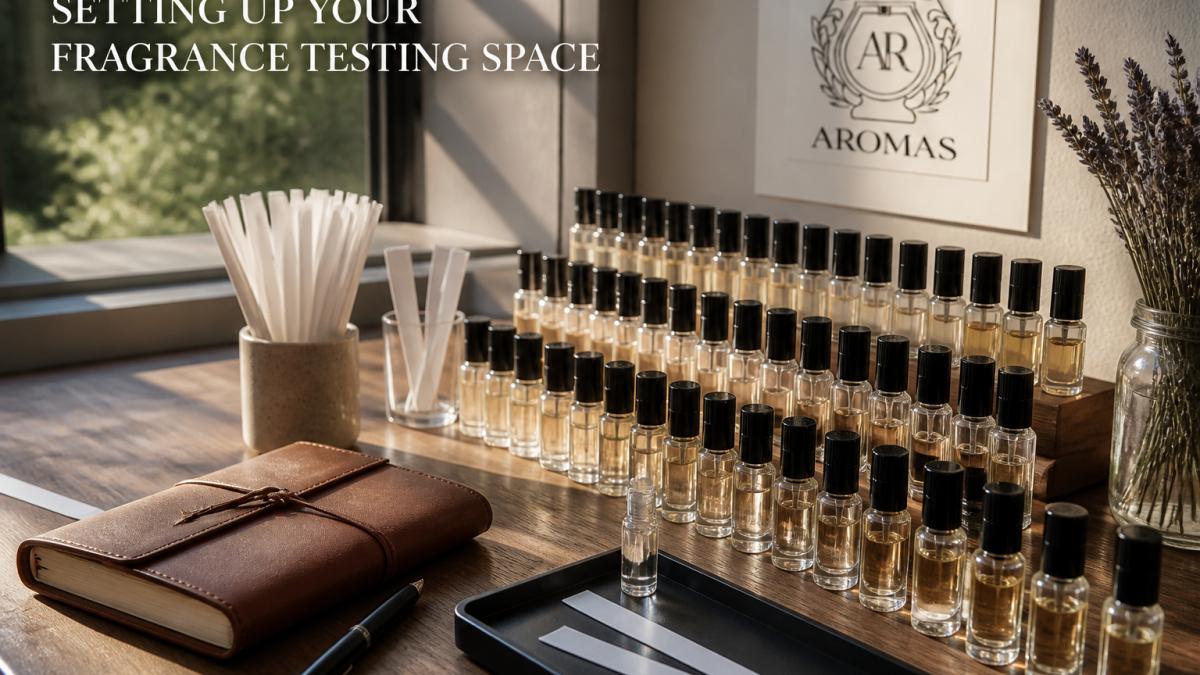
Organizing your samples and decants
Start simple. You need a clean, cool, dry place to store your collection. A drawer works. A shelf in a closet works.
Group your samples by category if you're testing many at once. Separate florals, woods, fresh scents, and orientals. This organization helps you track patterns in what you like.
Use a notebook or spreadsheet to log which samples you have. Note the brand, fragrance name, concentration (eau de toilette, eau de parfum, extrait), and the date you received it.
Storing samples properly for longevity
Decants and samples degrade when exposed to:
- Direct sunlight
- Heat above 70°F
- Humidity fluctuations
- Air exposure
Store your samples in a cool, dark place. A drawer in a bedroom closet is ideal. If you use a shelf, keep it away from windows. Never store fragrances in a bathroom, the humidity from showers breaks down the fragrance compounds.
Keep sample bottles upright and tightly capped. Loose caps let fragrance evaporate and let air oxidize what remains. Check caps before storing to make sure they're sealed.
If you're building a large collection, consider a small opaque storage box. These cost very little and protect your samples from light damage. Label the box clearly so you know what's inside without opening it repeatedly.
How to Test Perfume on Skin: A Step-by-Step Method
Testing fragrance on your skin is the most accurate way to evaluate how it will actually perform on you. Paper testing comes first, but skin testing reveals the real picture.
Preparing clean, dry skin
Start with clean skin. Shower or wash your forearms with unscented soap. Pat dry completely. Wait at least 15 minutes before applying fragrance. Your skin temperature needs to stabilize, and any residual moisture will dilute the scent.
Avoid applying lotion or oils beforehand. These interfere with how fragrance develops on your skin. If your skin is very dry, a light fragrance-free moisturizer is fine, just apply it well before testing.
Wear neutral clothing. Avoid clothes you've recently washed with heavily scented detergent. The detergent scent will compete with the fragrance you're testing and throw off your evaluation.
Applying one spray to the inner forearm
Apply exactly one spray to your inner forearm. This is the standard testing location because the skin there is thin, warm, and receives good air circulation. The warmth helps fragrance develop naturally.
Hold the sample bottle 6 inches from your skin. Spray once. That's it. Resist the urge to spray multiple times. One spray is the industry standard for a reason, it's enough to evaluate the fragrance without overwhelming your nose or making it impossible to test another sample later.
Don't rub your wrists together. Don't waft the fragrance toward your nose. Just let it sit. Rubbing breaks down fragrance molecules and accelerates the dry-down, which gives you false information.
Using Perfume Testing Blotter Strips for Initial Screening
Blotter strips (also called test strips or fragrance blotters) are your first line of defense when screening multiple samples.
A blotter strip is just absorbent paper.
How to use blotter strips:
Hold a strip vertically. Spray the fragrance once onto the top third of the strip. Bring the strip to your nose and smell. The opening will hit immediately.
Wait 30 seconds. Smell again. You're starting to catch the heart notes emerging.
Blotter testing is fast. You can screen 10 samples in 20 minutes. But blotter testing is incomplete. Paper doesn't replicate how fragrance develops on your skin.
How Long to Test a Perfume Sample
Time is your most important tool in fragrance evaluation. Rushing the process means missing crucial information about how the scent actually performs.
Waiting between application and evaluation
Wait at least 5 minutes after application before forming any opinion. The opening notes are volatile and don't represent the true fragrance. They fade quickly.
At 5 minutes, the top notes are clearing and the heart notes are emerging. This is when you start getting useful information. Smell your wrist. What do you notice? Is it pleasant? Does it feel like "you"?
At 15 minutes, the heart notes are fully developed. This is the main character of the fragrance. Most of your wearing time will be spent in this phase. If you don't like the heart, move on.
Tracking scent development over hours
Test a fragrance for a minimum of 3 hours. Many people stop evaluating after 30 minutes and miss the dry-down entirely. The dry-down is often the best part of a niche fragrance.
Check your fragrance at these intervals:
- 5 minutes (opening)
- 15 minutes (heart emerging)
- 30 minutes (heart full)
- 1 hour (heart established)
- 3 hours (approaching dry-down)
- 6 hours (dry-down)
Jot down your impressions at each checkpoint. What changed? Did the scent improve or decline? Is it still performing well, or has it faded to a whisper?
The dry-down is where niche fragrances often shine. While mainstream fragrances fade to nothing, quality niche scents often settle into a beautiful, subtle base that lasts for hours. You won't discover this if you quit testing after an hour.
How to Evaluate Perfume Notes and Scent Development
Understanding fragrance structure helps you evaluate what you're smelling and why it appeals (or doesn't) to you.
Understanding opening, heart, and dry-down
The opening (top notes) hits your nose first and lasts about 5-15 minutes. These are the brightest, most volatile notes, citrus, herbs, aldehydes. The opening creates the first impression but isn't representative of the full fragrance.
The heart (middle notes) emerges around 15 minutes and lasts 2-4 hours. This is the core of the fragrance. Florals, fruits, spices, and creamy notes live here. The heart is what you'll smell for most of the day.
The dry-down (base notes) begins around 4-6 hours and can last 8-24 hours depending on concentration and performance. Woody notes, musks, amber, and resins dominate here. The dry-down is subtle and skin-like. It's the ghost of the fragrance.
Assessing longevity, projection, and sillage
Longevity is how long a fragrance lasts on your skin. Test this over a full day. A quality niche fragrance in eau de parfum concentration should last at least 6-8 hours.
Projection is how far the fragrance travels from your skin. Spray once on your inner forearm. Walk into another room. Can you still smell it on yourself? That's projection.
Sillage is the scent trail you leave behind. It's related to projection but distinct. Spray once and walk away. Does the room smell like your fragrance? That's sillage.
A good niche fragrance balances these qualities. You want enough projection that you can smell it, but not so much that it overwhelms a room.
Creating Your Fragrance Evaluation Scorecard
A scorecard keeps your evaluations consistent and helps you compare fragrances fairly. Without structure, you'll rely on memory, which fades fast.
Create a simple table with these columns:
| Fragrance Name | Opening | Heart | Dry-Down | Longevity | Projection | Overall | Notes |
|---|---|---|---|---|---|---|---|
| [Name] | [1-5] | [1-5] | [1-5] | [1-5] | [1-5] | [1-5] | [Your impressions] |
Rate each element on a scale of 1-5. One means you didn't like it. Five means it's exceptional. "Overall" is your gut feeling after the full test.
The "Notes" column is where you capture specifics. Write what you actually smelled.
Test at least 3-4 fragrances this way before you start comparing. You need a baseline for your own preferences. Then you can see patterns. Maybe you consistently rate florals higher than woods. Maybe you love high projection.
Testing Multiple Niche Fragrances Without Olfactory Fatigue
Olfactory fatigue (also called nose fatigue) happens when your nose stops detecting a scent after prolonged exposure (pubmed.ncbi.nlm.nih.gov). It's a real phenomenon. Your olfactory system adapts to constant stimulation and essentially tunes it out.
This is why you can't test 10 fragrances in a row and expect fair evaluations. By sample six, your nose is exhausted. Your judgments become unreliable.
Spacing out comparisons across days
Test no more than 3-4 fragrances per day. Space them out over hours, not minutes. Test one in the morning, one at lunch, one in the afternoon. This gives your nose recovery time between evaluations.
If you're building a serious collection, test 2-3 fragrances per day over a week. You'll get much better information than cramming everything into one marathon session.
Keep detailed notes on each fragrance. By the end of a week, you'll have a clear picture of which ones resonated with you and which ones didn't.
Resetting your nose between samples
Between fragrances, step outside for fresh air. Breathe deeply. Let your olfactory system reset. Five minutes of fresh air is usually enough.
Some people smell coffee beans between fragrances. This is a myth. Coffee doesn't reset your nose. Fresh air does.
If you're testing at home, open a window. Step outside. Breathe in the natural scents around you. This gives your nose a genuine break.
Avoid testing a new fragrance immediately after eating strong foods. Garlic, coffee, and spices linger in your olfactory memory and interfere with fragrance evaluation.
Testing niche fragrances at home requires patience and structure, but it's the only way to make confident purchasing decisions. Our hand-decanted samples let you explore dozens of scents without financial risk.
Frequently Asked Questions
How long should I wear a perfume sample before deciding if I like it?
Wear a sample for at least 4-6 hours to experience the full scent development. Niche fragrances evolve significantly from opening through dry-down. Test on clean, dry skin on your inner forearm, and check the fragrance every hour. Take notes on how the scent changes. A full wear test across a complete day gives you the most accurate sense of longevity and how the fragrance interacts with your skin chemistry.
Should I test niche fragrance on skin or use a blotter strip first?
Use blotter strips for an initial screening to assess the fragrance profile without skin chemistry interference. Blotter testing shows the pure scent composition. However, always follow up with skin testing on clean, dry skin, since your body chemistry dramatically affects how a niche fragrance performs. Skin testing reveals longevity, projection, and how the fragrance develops over time, the real-world experience you need before committing to a full bottle.
How can I tell if a fragrance sample is authentic?
Authentic niche fragrance samples should have a scent that develops naturally through opening, heart, and dry-down phases. Counterfeits often smell flat or have off-putting chemical notes. Purchase samples from reputable providers who hand-decant from verified bottles. Check storage conditions, samples stored in cool, dark places maintain authenticity better. If a sample smells noticeably different from what you expect based on fragrance notes, it may be diluted or counterfeit.
How many niche fragrances should I test at once to avoid nose fatigue?
Test no more than 2-3 fragrances in a single session to prevent olfactory fatigue. Your nose becomes desensitized after smelling multiple scents, making evaluation unreliable. Space tests across different days for the most accurate assessment. If you're comparing several samples, create a shortlist of your top candidates, then test those 2-3 finalists on separate occasions. This approach gives you clear sensory evaluation and helps you identify your signature scent without sensory overwhelm.