

How to Spot Fake Perfume Decants: 7 Checks That Work
Last Updated: October 23, 2026
Quick Summary
To spot fake perfume decants, verify the seller first: a named business identity, a clear sourcing statement, and a written return policy are hard to fake, while dodged sourcing questions and no return policy are red flags. Then inspect the label, batch code, atomizer, and fill level, and compare the scent to a known sample using a controlled, blind side-by-side test at fixed checkpoints.
- Photograph the sealed decant and packaging the moment it arrives, before opening it, as dispute evidence.
- For scent comparison, apply one spray to each inner forearm about two inches below the elbow crease and do not rub.
- Judge the two samples at fixed checkpoints: opening at 0-5 minutes, heart at 20-40 minutes, and dry-down at 2-4 hours.
- If you have no authentic sample, compare two decants of the same fragrance from independent trusted sellers.
- A sharp alcohol blast or flat top note can come from heat, light, or recent filling rather than a fake.
Table of Contents
- Why Fake Perfume Decants Are So Hard to Catch
- Step 1: Verify the Seller Before You Buy
- Step 2: Inspect the Packaging and Bottle
- Step 3: Check Liquid Color, Clarity, and Volume
- Step 4: Compare Scent and Performance to a Known Sample
- Are Perfume Decants Authentic? What the Evidence Can and Cannot Prove
- Signs of Fake Perfume: A Decant-Specific Checklist
- Perfume Decant Storage and Shelf Life: What Handling Tells You
- Frequently Asked Questions
Why Fake Perfume Decants Are So Hard to Catch
A perfume decant is a small portion of an original fragrance transferred into a separate atomizer or vial. That rebottling is what makes fake perfume decants so hard to catch: once the liquid leaves the original bottle, the strongest proof of authenticity disappears with it.
At AR Aromas, we hand-decant every sample, so we know how much trust rides on that transfer. The buyer never sees the original bottle. They see a vial, a label, and a seller's word.
The Decanting Process and Where Fakes Enter
Legitimate decanting is straightforward: a seller draws a measured amount with a clean syringe, and fills a sterile atomizer, keeping the batch code, fill level, and packaging traceable.
Fakes enter at three points:
- The source bottle is counterfeit. The decant is real liquid from a fake bottle.
- The liquid is diluted or swapped. A cheaper fragrance, alcohol, or water fills the vial.
- The vial is refilled. A used atomizer gets topped up with something else.
Each scenario leaves different clues. No single check catches all three, which is why the steps below work as a set, not alone.
Step 1: Verify the Seller Before You Buy
Seller reputation is the first and strongest filter. A trustworthy decant seller is easy to check and hard to fake.
Start with these signals:
- A real business identity. A named owner, contact details, and a physical return address.
- A clear sourcing statement. The seller explains where bottles come from and how decants are prepared.
- A written return policy you can read before paying.
Red flags matter just as much: dodged sourcing questions, no return policy, or reviews that read like they were written in one sitting.
Marketplace recourse varies: a platform with buyer protection gives you a dispute path, while a direct message sale to a stranger gives you almost nothing. Know which one you are using before you pay.
Step 2: Inspect the Packaging and Bottle
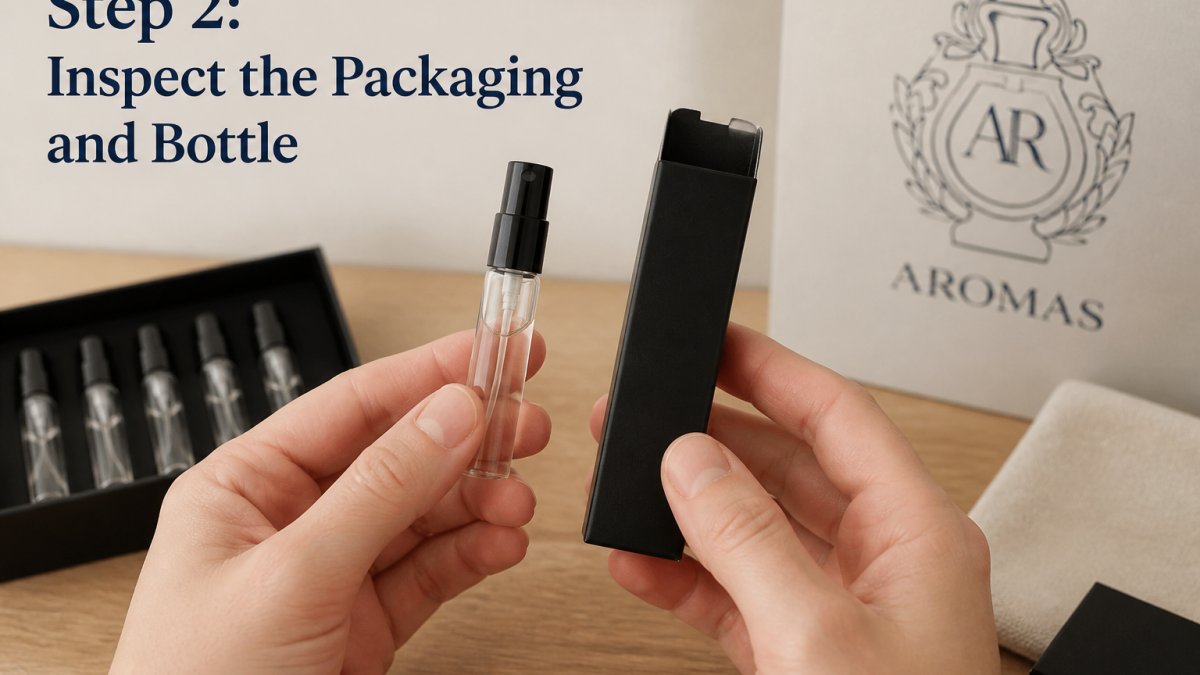
Good packaging does not prove authenticity, but sloppy packaging is a warning. Check the physical details on arrival.
Look at the bottle and label first:
- Label quality. Crisp print, straight alignment, correct spelling of the fragrance name.
- Atomizer function. A smooth spray with no drips or weak mist.
- Fill level. Consistent with what you paid for.
Now check the paper trail. A batch code or serial number on the label should match what the seller listed.
Step 3: Check Liquid Color, Clarity, and Volume
Visual checks are useful but limited: use them to catch obvious problems, not to confirm authenticity.
What to look for:
- Color. Should match the fragrance family and the known shade for that scent.
- Clarity. Clear liquid with no cloudiness or visible particles.
- Volume. Should match the stated size.
The catch: many authentic fragrances are naturally cloudy or colored, some darken with age, and some contain real ingredients that settle.
Color and clarity catch the clumsy fakes, watered-down liquid, visible contamination, a fill level that does not match the listing, but not a well-made counterfeit.
Step 4: Compare Scent and Performance to a Known Sample
A side-by-side comparison is the strongest single signal you can generate at home, but only if you control the variables. A loose wrist-to-wrist sniff proves little; a controlled comparison isolates the decant from skin chemistry, application volume, storage history, and batch variation.
Set Up a Controlled Comparison
Run the test the same way each time so results are comparable:
- Use the same skin site on both arms. Inner forearm, not wrist, the wrist bends, rubs on sleeves, and carries more incidental contact. Apply about two inches below the elbow crease on each arm.
- Match the dose. One spray from each atomizer, held the same distance (about four to six inches). A finer-mist decant atomizer will smell lighter at the opening even if the juice is identical.
- Do not rub. Rubbing crushes top notes and accelerates the dry-down, which flattens the exact differences you are trying to detect.
- Label the arms. Write "known" and "test" on a sticky note or use a marker dot. Blind testing, having someone else apply them without telling you which is which, removes expectation bias and is the biggest upgrade most buyers can make.
- Test at the same time of day. Skin temperature, humidity, and nose fatigue shift through the day; morning, before anything else is applied, is the cleanest window.
What to Compare and When
Judge the two samples at fixed checkpoints rather than sniffing continuously, which causes olfactory fatigue:
- Opening (0-5 minutes): Compare the first impression. Look for sharp alcohol burn, a hollow or missing top note, or an abrupt chemical edge. A genuine fragrance can still open harsh if decanted recently or stored warm, so treat a harsh opening as a question, not a verdict.
- Heart (20-40 minutes): The middle notes should track the reference. Divergence here, a flat floral, a metallic undertone, a sweetness that does not belong, is more meaningful than an opening difference.
- Dry-down (2-4 hours): Base notes are where dilution and swapping most often show. A diluted fragrance often collapses to alcohol and a faint ghost of the original. A swapped cheap fragrance frequently reveals a generic woody-amber base that does not match the reference.
Account for the Confounders
A mismatch is not proof of a fake. Rule out these causes before concluding anything:
- Storage history. Heat, light, and repeated air exposure oxidize juice and mute top notes. A decant that sat in a hot mailbox for two days can smell flatter than the same fragrance stored cool. Ask how and when it was shipped.
- Batch variation. Fragrance houses reformulate and source raw materials seasonally. Two authentic bottles of the same scent from different years can differ noticeably in the opening and in sweetness. Check the batch code on the source bottle if the seller provides it.
- Concentration and atomizer differences. A decant of eau de parfum sprayed from a fine atomizer can read lighter than an eau de toilette from a heavier sprayer. Compare concentration to concentration.
When the Comparison Is Inconclusive
Some fragrances are simply hard to judge from a decant: very light citruses that fade within an hour, heavy natural materials that vary by batch, and scents that rely on a specific atomizer for their opening. If the comparison is close but not conclusive, do not force a verdict, escalate to the evidence trail (source-bottle photos, filling-process documentation, and the seller's return policy) rather than treating one ambiguous wear as proof either way.
Are Perfume Decants Authentic? What the Evidence Can and Cannot Prove
Perfume decants can be authentic, but no single check proves it. Decants carry more risk than sealed bottles because the original packaging is gone, so evidence, not vibes, separates a real decant from a fake.
Here is what each type of evidence can and cannot tell you:
| Evidence | What It Proves | What It Cannot Prove |
|---|---|---|
| Seller reputation and return policy | Accountability and recourse | The liquid itself |
| Batch code and receipt | Source bottle traceability | That the vial was not refilled |
| Color and clarity | Rules out obvious fakes | Confirms a good one |
| Scent comparison | Strong signal of match | Batch and storage differences |
| Packaging and atomizer | Handling quality | Authenticity of the contents |
The takeaway is simple. Stack evidence. One strong signal is good. Three agreeing signals are better. A seller who welcomes questions and backs their product with a return policy is doing the work that fakes cannot fake.
Signs of Fake Perfume: A Decant-Specific Checklist
Most counterfeit guides focus on sealed bottles and retail packaging. Decants need their own checklist. Use this one before and after you buy.
Before you buy:
- Seller has a named identity and contact details
- Sourcing and decanting process are explained
- Return policy is written and clear
When it arrives:
- Label is crisp and correctly spelled
- Batch code matches the listing
- Scent matches a known sample on opening and dry-down
Perfume Decant Storage and Shelf Life: What Handling Tells You
Most guides treat storage as a side note. For decants it is central: a decant's small volume and non-original container make it far more sensitive to handling than a sealed bottle. Understanding why juice degrades tells you which arrival problems point to a careless seller and which point to a fake, and those are not the same thing.
The Four Mechanisms That Change a Decant
A fragrance is a balance of aroma compounds, alcohol, and water. Four forces disturb that balance after decanting:
- Oxidation. Oxygen reacts with aroma compounds and alcohol, muting top notes first and eventually producing a flat, stale, or slightly sour character. A decant's high surface-area-to-volume ratio means it oxidizes faster than a full bottle, and every spray lets fresh air in.
- Light degradation. Ultraviolet and even bright visible light break down many aroma molecules, especially citrus and floral components. Clear glass offers almost no protection; dark glass, opaque plastic, and cardboard tubes do.
- Heat. Warm storage accelerates every chemical reaction, including oxidation and the breakdown of delicate notes. A decant that sat in a hot delivery truck or a sunny mailbox can arrive smelling sharper or flatter than the same juice stored cool.
What Good Handling Looks Like
A seller who understands these mechanisms shows it in the details:
- Cool, stable storage before shipping, not a hot warehouse, a car trunk, or a sunny windowsill.
- Protective shipping that keeps the vial upright and insulated from temperature swings, especially in summer and winter.
Shelf Life: What to Realistically Expect
There is no universal expiration date for a decant; shelf life depends on the fragrance family, concentration, container, and storage. Common patterns practitioners report:
- Citrus-forward and light fresh scents are the most fragile and can lose their top notes within months even when stored well.
- Florals vary widely; some hold for a year or more, others fade noticeably faster.
- Woody, resinous, amber, and oriental compositions tend to be the most stable and often hold up for a year or longer when kept cool and dark.
Treat these as tendencies, not rules. A decant stored in a cool, dark drawer will outlast the same decant kept on a sunny bathroom shelf by a wide margin.
How Handling Effects Can Mimic a Fake
This is the part most buyers miss. Several handling problems produce symptoms that look exactly like counterfeiting:
- A sharp alcohol blast on first spray can come from a decant that was filled recently and has not settled, or from one stored warm, not necessarily from dilution.
- A flat or missing top note can result from oxidation during shipping, especially in a clear vial.
- Cloudiness or sediment can appear in genuine fragrances that contain natural materials or that were stored cold; it is not automatically contamination.
Store Your Own Decants Correctly
Once a decant is yours, you control its fate. Keep it cool (a dark drawer or closet beats a bathroom shelf), out of direct light, tightly capped, and upright, and avoid cars or radiators. For storage beyond a few months, a dark glass vial with a tight seal is worth the small upgrade over clear plastic.
Frequently Asked Questions
How can you tell if a perfume decant is fake?
Start with the seller: check for a verifiable business presence, clear sourcing statements, and a return policy. Then inspect the vial for clean labeling, a secure atomizer, and no leaks. Compare the liquid's color and clarity to a known authentic sample, and test the scent on skin for 6-8 hours. A real decant should match the original's opening notes and dry-down. If the price is far below typical market value or the seller dodges questions about the source bottle, treat it as a warning sign and walk away.
Are perfume decants authentic, or are they usually diluted?
Authentic decants are simply fragrance transferred from an original bottle into a smaller vial, so the liquid should be identical to the source. The risk comes from sellers who refill vials with diluted or counterfeit juice. You can reduce that risk by buying from sellers who show the batch code and who offer refunds. If a decant smells weaker than expected or fades within an hour, dilution is possible, but storage and skin chemistry can also affect performance, so test before concluding.
What are the signs of fake perfume in a decant?
Common signs include a price far below market value, a seller with no verifiable history, a vial with crooked or smudged labels, visible particles or cloudiness in the liquid, a leaking atomizer, and a scent that smells harsh or chemical rather than layered. Also watch for packaging that arrives without any batch code. A single sign is not proof, but two or more together justify asking the seller for documentation or requesting a refund before you use the product.
How should perfume decants be stored, and how long do they last?
Store decants upright in a cool, dark place away from sunlight and heat, ideally in a closed box or drawer. Keep the atomizer capped and avoid repeated temperature swings. Most decants stay in good condition for 1-3 years when stored properly, though citrus-forward scents can fade faster. If the liquid turns cloudy, develops visible particles, or smells sour or metallic, discard it. Proper storage also protects the scent profile and projection you paid for.
