

Why Try Perfume Samples Before Buying
Table of Contents
- Why Try Perfume Samples Before Buying a Full Bottle
- How to Test Perfume Samples Correctly
- How Long to Test a Perfume Sample Before Deciding
- Perfume Sample vs. Full Bottle: Cost and Value
- Niche Perfume Samples for Beginners: Where to Start
- Building Your Testing Protocol: A Step-by-Step Guide
- Common Mistakes to Avoid When Testing Samples
- Frequently Asked Questions
Last Updated: October 11, 2026
Why Try Perfume Samples Before Buying a Full Bottle
Testing perfume samples before buying a full bottle prevents buyer's remorse. A fragrance that smells amazing on a paper strip or in the store can smell completely different on your skin due to your unique body chemistry.
Sampling lets you discover what actually works for your skin chemistry before investing in a full bottle.
Fragrance develops in layers over time. What you smell in the first five seconds differs dramatically from what you experience after two hours, so wearing a sample through a full day is essential to understanding if a scent is right for you.
How to Test Perfume Samples Correctly
Testing samples correctly transforms them into a genuine evaluation tool. Most people apply samples incorrectly and never get an accurate sense of how the fragrance performs.
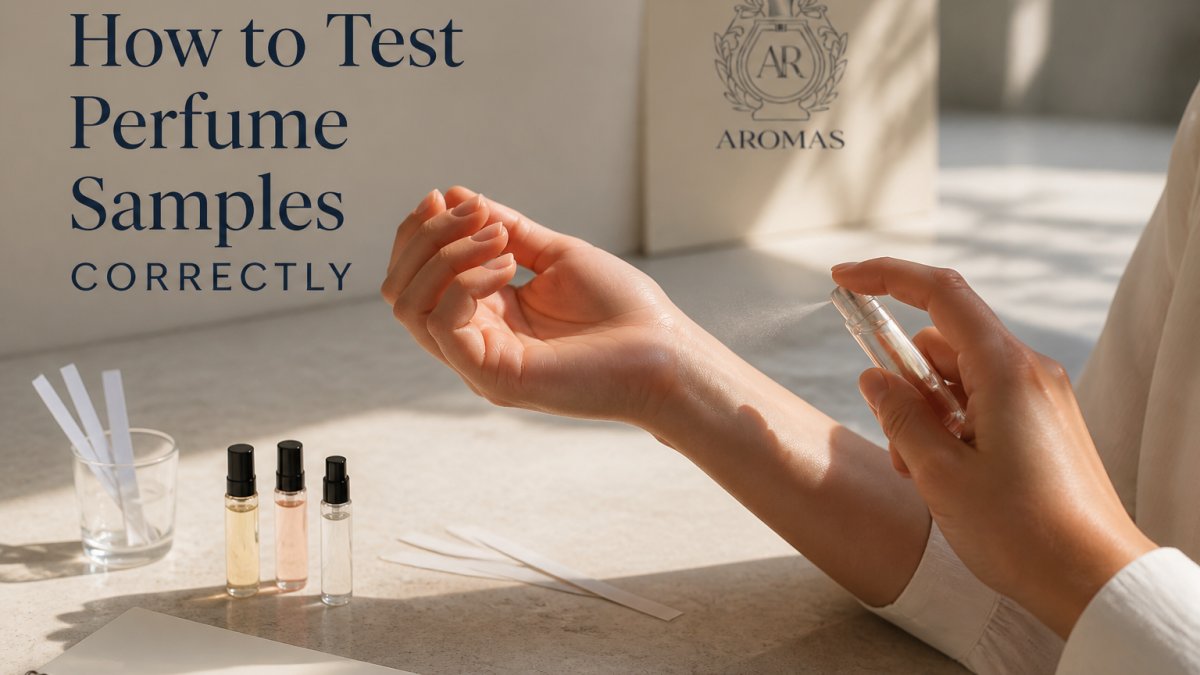
Testing on Skin vs. Paper Strips
Your skin is the only true testing ground for fragrance. Paper strips give an initial impression but don't capture how the fragrance interacts with your body chemistry or how skin warmth affects top note development.
Apply samples to pulse points where your body generates heat: inner wrists, behind ears, inside elbows, and the base of your throat. Spray once or twice on each pulse point; overapplying masks the true scent profile and wastes product.
Never rub your wrists together after applying. This breaks apart the fragrance molecules and disrupts the natural development of the scent. Let it settle on your skin untouched for the first few minutes.
Avoiding Scent Fatigue and Blind Spots
Scent fatigue occurs when your nose adapts to a fragrance after wearing it for a while. Testing multiple samples in one session overwhelms your nose and makes fair comparison impossible.
Test no more than three samples in a single day. Space them out on different pulse points or test them on different days entirely. If you're testing several fragrances, take breaks between applications. Step outside for fresh air. Smell coffee beans if you have them, it resets your olfactory system and clears scent fatigue.
Keep written notes on your first impression, the scent at 30 minutes, and at the two-hour mark. These notes become invaluable when deciding whether to buy the full bottle weeks later.
How Long to Test a Perfume Sample Before Deciding
One application isn't enough to make a buying decision. You need to wear a sample across multiple days to understand its true performance and whether it fits your life.
Most fragrance experts recommend testing a sample for at least three to five days before deciding to purchase the full bottle. This timeframe lets you experience the scent in different environments and at different times of day.
By day three, you've worn it through different activities. By day five, you know whether the scent stays interesting and how long it lasts on your skin.
Don't rush the decision. Fragrance is personal, and the cost of a sample is minimal compared to a full bottle you'll regret.
Perfume Sample vs. Full Bottle: Cost and Value
The real value of sampling emerges when you calculate cost-per-wear and understand what a full bottle actually costs over time.
A full-size bottle contains 50-100 milliliters and costs $80-$200 or more. The decision becomes clearer when you factor in actual wear patterns.
A single application uses roughly 0.1 milliliters, so a 1-milliliter sample gives approximately 10 wears. Testing over five days uses roughly half a milliliter, leaving enough for additional confirmation wears before committing to a full bottle.
If a full-size bottle costs $120 and contains 50 milliliters, and you wear it three times per week, your cost-per-wear is approximately $2.40. If you wear it five times per week, cost-per-wear drops to $1.44.
Sampling lets you test whether a fragrance will actually become part of your rotation. If you test a fragrance for five days and wear it only out of obligation, not excitement, that's a signal to skip the full bottle.
Samples let you build a fragrance wardrobe strategically. Instead of owning one $150 full bottle, you can own samples of eight fragrances for roughly $50 total, giving you flexibility to rotate based on season, mood, or occasion.
A sample-based wardrobe lets you switch between scents and prevent olfactory fatigue, extending the enjoyment of each fragrance.
Samples are ideal for travel: a 1-milliliter sample fits in a pocket, weighs almost nothing, and poses no risk if it leaks, unlike a full bottle.
If you test a sample and genuinely love it, wear it multiple times per week, and know you'll continue wearing it for months, the full bottle becomes the economical choice. The key is testing first so you're confident in that decision.
Niche Perfume Samples for Beginners: Where to Start
If you're new to fragrance sampling, start with niche fragrances. Niche perfumes offer more interesting compositions and unique scent profiles, and sampling makes the biggest difference with complex, less familiar fragrances.
Platforms like AR Aromas specialize in curated niche fragrance samples. Hand-decanted samples from authentic sources ensure you're testing the real product, not a diluted or counterfeit version.
When choosing your first samples, pick fragrances based on scent families you already know you like. This makes the learning curve gentler and helps you build confidence in your preferences.
Consider samples like Café Rose (Turkish rose and coffee), Greenly (fresh apple and citrus), Herod (warm spice with tobacco and incense), or Orza (gourmand with fruit and vanilla) to explore different scent families.

Building Your Testing Protocol: A Step-by-Step Guide
A structured testing protocol removes guesswork from fragrance evaluation and reduces bias. Follow this framework every time you test a new sample, and keep written records so you can compare fragrances fairly weeks later.
Preparation: Minimize Bias and Scent Fatigue
Test no more than two fragrances in a single day. Your olfactory system adapts to fragrance within 15-20 minutes of continuous exposure; testing three or more samples in one session overwhelms your nose and makes fair comparison impossible.
Apply the first sample to your inner left wrist and the second to your inner right wrist. Take a 10-minute break and step outside for fresh air between applications to reset your olfactory receptors.
Smell coffee beans for 20-30 seconds between fragrances to reset your olfactory system. This standard practice significantly reduces scent fatigue.
Remove competing scents from your environment. Avoid wearing other fragrances, scented lotions, or cologne, and wash your hands with unscented soap.
Day One: Application, First Impression, and Dry-Down
Apply the sample to a pulse point using one or two sprays. Do not rub your wrists together; this breaks apart fragrance molecules. Let the fragrance settle for 30 seconds before smelling it.
Record your immediate reaction within the first minute. Be specific: instead of "smells good," write "bright lemon with a hint of bergamot" or "heavy floral, almost soapy."
Smell the fragrance again at 5 minutes. Write down what you smell now and whether it's different from your first impression. This transition is crucial; many fragrances smell promising initially but become unpleasant as they develop.
At the two-hour mark, smell the fragrance again. Record how the scent has evolved. A fragrance that smells fresh and citrusy initially but becomes heavy and musky by hour two may not be suitable for all-day wear.
At the four-hour mark, evaluate longevity. Can you still smell the fragrance, or has it faded? Does it still smell good, or has it become unpleasant?
Days Two Through Five: Repeat Wear, Skin Chemistry, and Emotional Response
Wear the same sample on day two at a different time of day. Your skin chemistry changes throughout the day, so testing at different times reveals how the fragrance performs across your natural skin variations.
On day two, pay attention to how the fragrance responds to your activities, exercise, showers, and different environments. Real-world performance matters more than laboratory conditions.
On day three, focus on your emotional response. Are you excited to apply it, or wearing it out of obligation? A fragrance you dread wearing is a fragrance to skip. A fragrance you reach for eagerly is a strong candidate for a full-bottle purchase.
Days four and five confirm your decision. By now, you should have a clear sense of whether this fragrance belongs in your collection. If you're still on the fence after five days, the fragrance probably isn't a strong match.
Record Keeping: Create a Fragrance Testing Log
Maintain a testing log for each sample including: fragrance name and source, date tested, first impression, heart notes, dry-down, longevity, skin chemistry notes, emotional response, longevity rating, projection rating, and overall verdict.
Written records let you compare fragrances objectively weeks later.
The Final Decision: Measurable Criteria for Buying a Full Bottle
After five days of testing, ask yourself: Did I wear this sample every day? Did it last 4-6 hours? Did the dry-down smell good? Does it work for my environment? Is the cost-per-wear justified? Does it add something new to my collection? Did it smell consistent across multiple days?
If you answer yes to at least four of these questions, a full-bottle purchase is justified. If you're hesitating on more than two, skip it and move on to the next sample.
Common Mistakes to Avoid When Testing Samples
The biggest mistake people make when testing samples is testing too many at once. Your nose can't fairly evaluate three fragrances simultaneously. You'll confuse the scents, experience scent fatigue, and make poor decisions.
Another common error is applying too much sample. One or two sprays per pulse point is sufficient. Overapplying wastes product and creates an overwhelming scent that doesn't reflect how you'd actually wear a full bottle.
Don't test a sample for only one day and then decide. One wear isn't enough time to understand how a fragrance performs on your skin and whether it stays interesting over time. Commit to at least three days of testing.
Avoid storing samples in direct sunlight or extreme heat. Fragrance degrades when exposed to light and temperature fluctuations. If your samples are stored poorly, you're not testing the true fragrance, you're testing a degraded version. Authentic samples from trusted sources like AR Aromas arrive in proper storage conditions.
Finally, don't let other people's opinions override your own experience. A fragrance that everyone loves might not work for your skin chemistry. Trust your nose and your preferences. Fragrance is personal, and the only opinion that matters is yours.
Testing perfume samples before buying is the smartest way to build a fragrance collection that actually reflects your taste and works for your life. Samples eliminate the risk of expensive mistakes and let you explore niche fragrances without financial commitment. Start with AR Aromas's curated selection of authentic, hand-decanted samples. Our fast shipping and carefully prepared products ensure you're testing genuine fragrances that perform exactly as intended.
Frequently Asked Questions
Why should you try perfume samples before buying a full bottle?
Perfume samples let you test how a fragrance wears on your skin chemistry over hours or days without committing to a $100+ full bottle. You discover whether the scent develops pleasantly, lasts all day, and matches your taste before spending significant money. Samples also reduce the risk of expensive purchase regret and let you explore niche fragrances you've never encountered before.
How long should you test a perfume sample to make a real decision?
Test a sample for at least three to five days of wear. The first day shows you the opening and dry-down; subsequent wears reveal how the fragrance evolves and whether it stays pleasant throughout the day. A single test isn't enough because scent fatigue can mask how the fragrance actually performs, and your skin chemistry may interact differently on different days.
Are niche perfume samples worth buying compared to mainstream travel sizes?
Yes. Niche perfume samples let you explore exclusive fragrances unavailable at department stores. For beginners, samples like Café Rose ($4.99) or Greenly ($4.99) are affordable ways to discover whether niche scents match your preferences before investing in a full-size bottle, which often costs $150 or more.
How do you know if a perfume sample is authentic and properly stored?
Buy from reputable sources like AR Aromas, which hand-decants samples from authenticated bottles and ships them quickly to preserve quality. Check that the sample has consistent color, proper spray mechanism, and no signs of evaporation. Authentic decants maintain the full scent profile and longevity of the original fragrance when stored and shipped correctly.